.png)
PLATFORM
ECOSYSTEM
MARKETPLACE
IMPACT
RESOURCES
ABOUT
Turning fragmentation into functioning and investable markets
Impact is becoming a core condition for how markets operate. Powerful
forces are converging across industries — from planetary boundaries
and policy shifts to capital flows and technological advancement.
Value is no longer created through isolated transactions — but through systems that align
actors, incentives, data, and execution over time. Yet today, these systems remain fragmented.
Capital, regenerative solutions, and outcomes are disconnected — limiting their ability to scale.
This creates a fundamental challenge: how do we design markets capable of
coordinating diverse actors, industries, and sectors around shared outcomes?
%20(2).png)
Making regenerative markets work requires a new kind of market logic —
one built on trust, coordination, transparency, integration, and verified impact.
It requires more than collaborative action within systems — it requires designing and connecting them. Regeneration is a property of how markets are designed and operate.
This thinking is developed in our upcoming book Making Regenerative Markets Work — where
we define what it takes to design and activate these markets as coherent, scalable systems.
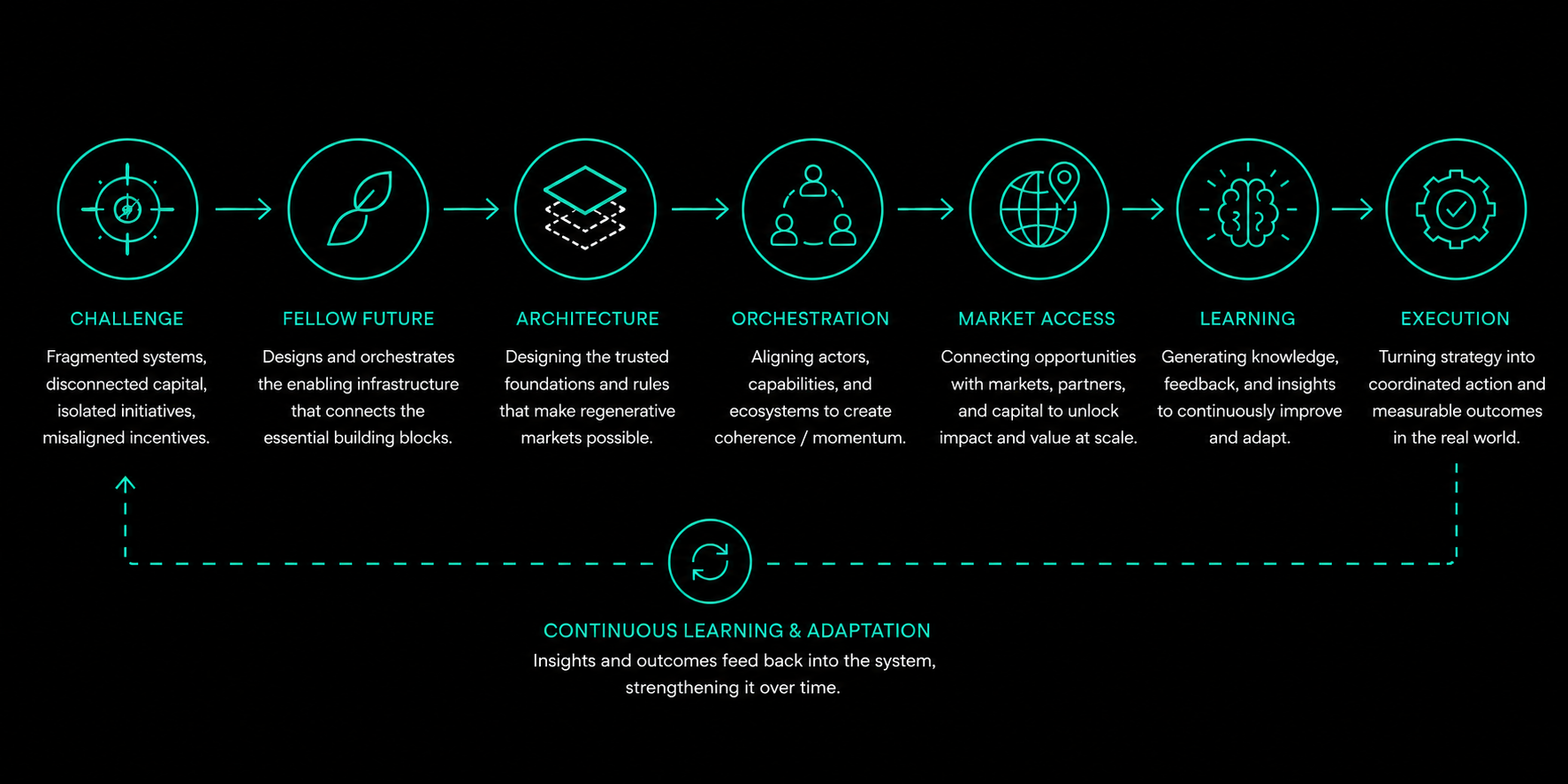
Regenerative markets emerge when the conditions for trust, coordination, market access, capital, learning, and execution are intentionally designed and connected.
Most initiatives address only some of the functions needed. We orchestrate them through a coordinated market system that enables collaboration, learning, and long-term value creation.
As they reinforce one another, regenerative opportunities become investable, learning compounds, execution becomes coordinated, and successful models can be repeated, combined, and scaled.
This is how real transformation happens.
Transformation also starts from within — and grows through connection.
The ability to create change around us is shaped by how we see, think, learn and relate to others. Developing awareness, new perspectives, courage and the capacity to navigate complexity strengthens our ability to collaborate, lead and act differently.
Through learning, reflection, dialogue, co-creation and events, we create spaces where inner development connects with collective action — and where partners can bring their own
expertise, methods and perspectives into shared journeys, experiences and solutions.
Reflect → Learn → Connect → Co-create → Act → Adapt
If regeneration is a property of how markets are designed, then
impact at scale depends on a set of core functions working together.
Fellow Future connects the key enablers required for regenerative markets to thrive:

Making impact repeatable is what allows it to scale.
Regenerative projects and initiatives often struggle to scale. Capital,
governance, market access, learning, and execution are rarely connected.
By connecting these elements into repeatable market infrastructure, successful
initiatives become investable, transferable, and scalable across regions and sectors.
As more actors participate, every successful implementation strengthens the system —
making future projects, ventures, and solutions faster, more trusted, and easier to scale.
Systems that work once are a proof.
Systems that work repeatedly are infrastructure.
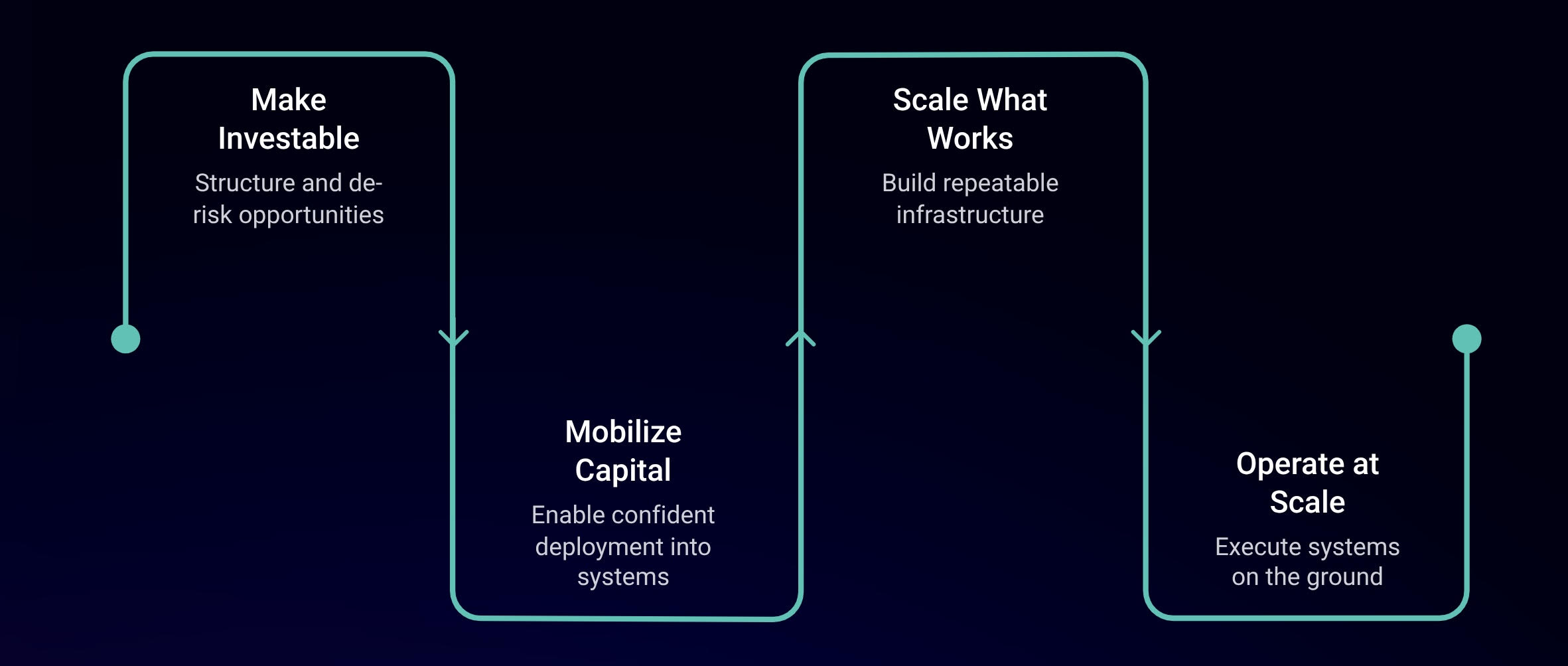
The FF Impact Engine™ operationalizes the key elements required for regenerative markets
to thrive. Together, these drivers enable markets to coordinate, learn, and scale over time.
Align interests, incentives and financial flows around shared outcomes — creating the conditions for actors to collaborate, contribute and create value.
Enable capital to flow toward credible opportunities connecting capital with impact, sustained performance, resilience, and long-term value creation.
Create systems that continuously learn and evolve — integrating verified data, feedback, and performance signals into into how markets operate over time.
Making impact measurable and verifiable — using data, standards, and technology to enable coordination, transparency and trust across actors and ecosystems.
With the right infrastructure in place, markets can begin to function as integrated, regenerative systems, capable of scaling impact and value over time.
As participation grows, value compounds, and these markets become self-reinforcing.

The coming decades will see unprecedented investment in natural capital, climate resilience, regenerative agriculture, circular production, and nature-based solutions.
Many of the greatest opportunities will emerge where capital, technology, governance,
and local implementation come together to create investable regenerative markets.
The future won't be built by individual organizations.
It will be built by connected ecosystems.
Join the Ecosystem →