.png)
PLATFORM
ECOSYSTEM
MARKETPLACE
IMPACT
RESOURCES
ABOUT
Shaping how we understand value and the future of regenerative markets
The transition requires more than technology and innovation. It requires
a broader understanding of value, better ways of designing markets,
projects, solutions, and the trusted infrastructure that connects them.
The principles that follow provide the foundation for how we think about systems,
value creation and the conditions that allow people, markets and nature to thrive.
They are meant to be explored, reflected upon and returned to over time.

In today’s economy, capital enables investment, innovation and growth.
But money is only one expression of value — not value itself.
Healthy ecosystems, trusted institutions, human knowledge, resilient communities
and strong partnerships and relationships are foundations of lasting prosperity.
Sustainable growth depends on recognizing and strengthening these forms of value.
Financial capital can accelerate that process, but it cannot create them on its own.

Regeneration needs three fundamental forms of infrastructure — physical, social
and natural. Each plays a different role, but none creates lasting value in isolation.
Physical infrastructure enables activity. Social infrastructure enables organisation. Natural infrastructure sustains life, and relational infrastructure enables them to work together.
Regenerative markets recognise their interdependence and seek to strengthen all three — creating the conditions for resiliece, thriving ecosystems and long-term economic value.
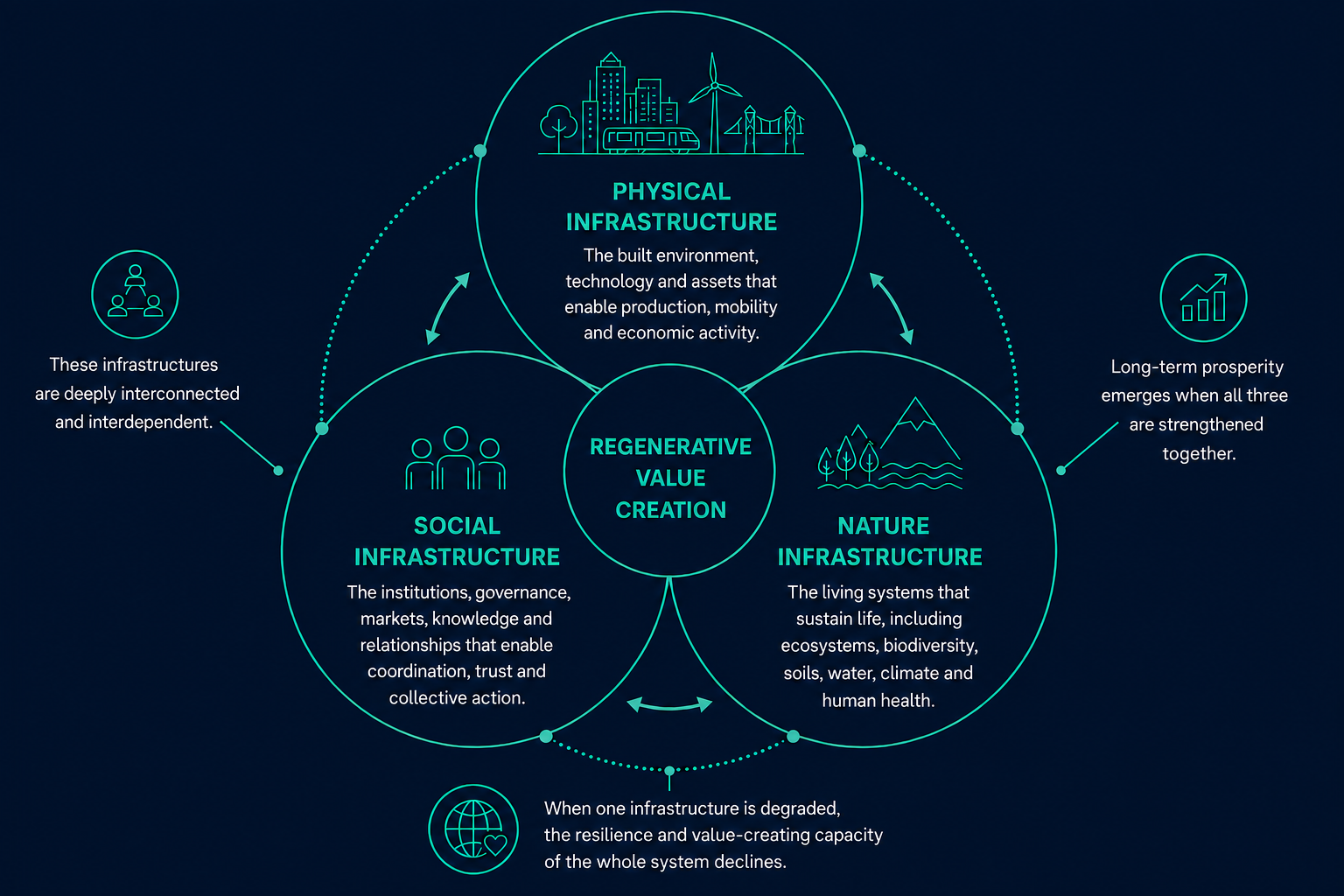
This is why regenerative markets require a systems perspective.
Capital alone cannot regenerate ecosystems.
Technology alone cannot build resilient communities.
Policy alone cannot transform markets.
Long-term value emerges when physical, social and organic infrastructure work together
and reinforce one another. How this looks will differ from one actor and place to another.
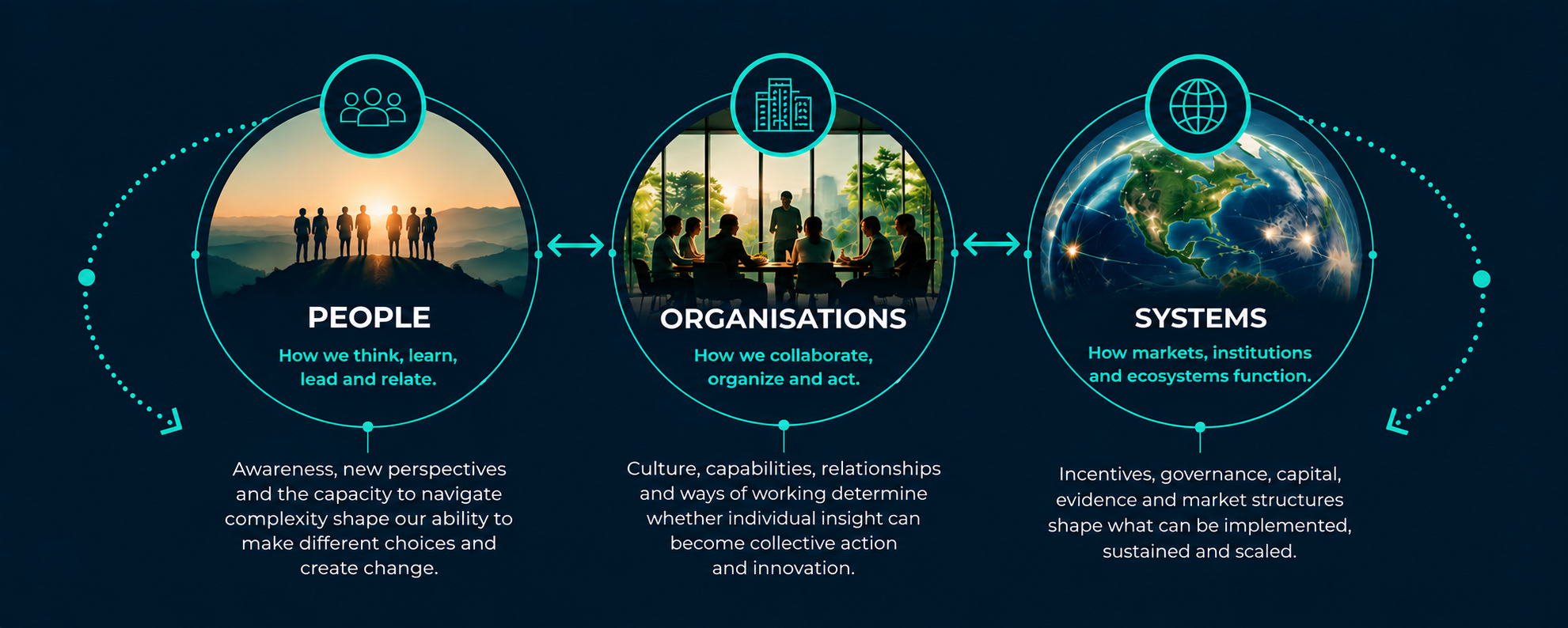
Regenerative transformation happens across people, organisations and the systems they are part of. Change at one level can enable change at another — but lasting transformation requires them to evolve together.
People shape organisations. Organisations shape systems. Systems shape the conditions in which people and organisations operate. Transformation happens through the interaction between all three.
Prosperity emerges where people, communities, organisations and ecosystems
have the conditions they need to grow, adapt and contribute over time.
This means investing in the conditions that enable resilience: healthy ecosystems, trusted institutions, capable organisations, knowledge, collaboration and shared infrastructure.
Regenerative markets are built by increasing the capacity of the systems they depend on.
%20(39).png)
Markets do not exist independently of the people and institutions that shape them.
They emerge through relationships, governance, incentives, norms and shared ways of understanding value. If we are enabled to change, the conditions and markets can evolve.

Shared governance, standards, interoperable systems, and trusted partnerships reduce friction, increase transparency and enable value to flow across value chains, sectors and geographies.
Resilient markets are built by investing in the market infrastructure that connects them.

Regenerative markets should be designed to evolve — strengthening
the people, organizations and ecosystems they connect and engage
rather than maximizing extraction, short-term efficiency and gain.
Resilience cannot be obtained through optimization alone. It emerges from healthy systems,
trusted relationships, distributed intelligence, and the capacity to learn and adapt over time.

We need to shift from machine thinking to living-systems thinking —
and from leading systems and organizations to facilitating ecosystems.
Rather than seeking to control complexity, we strengthen the relationships
and conditions that allow the system itself to learn, adapt and evolve.

Lasting transformation begins with the capacity to see differently, to
think systemically, and act with courage, curiosity, intention, and love.
The transition requires new ways of thinking, relating and leading. Lasting change depends on our ability to embrace complexity, collaborate across boundaries, continuously learn and adapt.
External transformation and internal development are deeply connected. The systems
we build ultimately reflects the mindsets, values and relationships that shape them.

Every person, organization and community carries unique knowledge,
experience and potential. Unlocking this potential is central to regeneration.
By creating conditions for agency, creativity, responsibility and meaningful
participation, we enable people, communities, and organizations to actively
contribute and shape systems that can learn, adapt and regenerate over time.

Humility means acting with intention without assuming certainty. We listen before prescribing, respect different forms of knowledge and lived experience, and remain open to being wrong.
As builders, investors, and participants, our role is not to control outcomes, but to strengthen
the relationships, capabilities and conditions from which better outcomes can emerge.

Diversity strengthens collective intelligence, creativity and adaptability — when people have meaningful opportunities to participate and influence decisions. By enabling different actors to meet and challenge assumptions, it becomes a source of learning, innovation and resilience.

People create change. Markets create scale. New ideas, leadership, and new
ways of thinking emerge through individuals and the organisations they build.
But lasting impact depends on shared market capability — the coordinated governance,
infrastructure, capital pathways, technology, and trusted relationships that connect people, organizations, projects and solutions into scalable markets. Neither is sufficient on its own.
Transformation begins within people. It scales through shared infrastructure.

The greatest opportunities emerge when people and organizations work together.
Regenerative markets emerge when actors align around purpose, complementary capabilities, and trusted relationships. Together, they create outcomes that no actor could achieve alone.

Lasting value is created by strengthening the conditions that enable
innovation, individuals, organizations, and future generations to thrive.
Regenerative markets recognize that today's decisions shape tomorrow's possibilities.
Rather than maximizing short-term returns, they invest in resilience, knowledge,
relationships, and the long-term health of the systems they depend on.
Every initiative and investment should leave the system stronger than it was before.

Long-term prosperity depends on how well we care for the systems that sustain it.
Regenerative leadership is rooted in stewardship. It means taking responsibility for the prosperity and health of the people, organizations and ecosystems that make value creation possible.
It creates the conditions for value to renew, circulate and grow stronger over time. It recognizes
that organizations, institutions and natural systems are held in trust for future generations.
The ultimate measure of success is not what we own, but what we enable to flourish.

The principles on this page are more than ideas. They form the
foundation of the future we believe is both possible and necessary.
We believe that every person, community, and organization already possesses the
knowledge, experience and capacity to contribute. Collaboration is the foundation,
enabled by shared infrastructure, trusted governance, and continuous learning.
Technology, capital and innovation should serve the essentials of life.

Our approach builds on decades of research and practice across systems
thinking, living systems, regenerative economics, market design,
governance, organizational development, innovation and leadership.
We work at the intersection of different fields, exploring markets as interconnected systems.
We combine these perspectives with original research, practical implementation and continuous learning. Our aim is to transform these insights into trusted infrastructure
that enables lasting value, that supports business, transformation, nature and life.
Explore the Platform