.png)
PLATFORM
ECOSYSTEM
MARKETPLACE
IMPACT
RESOURCES
ABOUT
Building trusted infrastructure for coordination and verified impact
Regenerative markets require more than projects, and capital — they require transparent governance, validation, trusted infrastructure, and operating logic.
The FF Governance Model™ embeds these capabilities directly into the system, including accountability structures, decision-making frameworks, and integrity mechanisms required
for complex ecosystems to function with trust, transparency, and long-term confidence.
This creates the institutional conditions required for regenerative ecosystems to scale with
trust, interoperability, transparency, and coordinated execution across sectors and regions.
%20(27).png)
Designed to connect corporate and ecosystem governance, the FF Governance model creates
a shared architecture across projects, partners, transactions, and impact flows — ensuring
that collaboration, execution, and value creation remain aligned as the ecosystem grows.
The model also defines how roles, responsibilities, approvals, and accountability
are structured across the ecosystem as participation and complexity increase.
│ Strategic Governance
Sets the policies, principles, and accountability structures that guide integrity and alignment.
│ Operational Governance
Coordinates validation, workflows, reporting, partnerships, and execution across the ecosystem.
│ Ecosystem Governance
Coordinates ecosystem participation, collaboration, partner alignment, and accountability.
│ Technical Governance
Maintains secure transactions, trusted data integrity, and interoperable system architecture.
│ Advisory & Oversight
Provides independent expertise, audits, review, continuous feedback, and improvement.
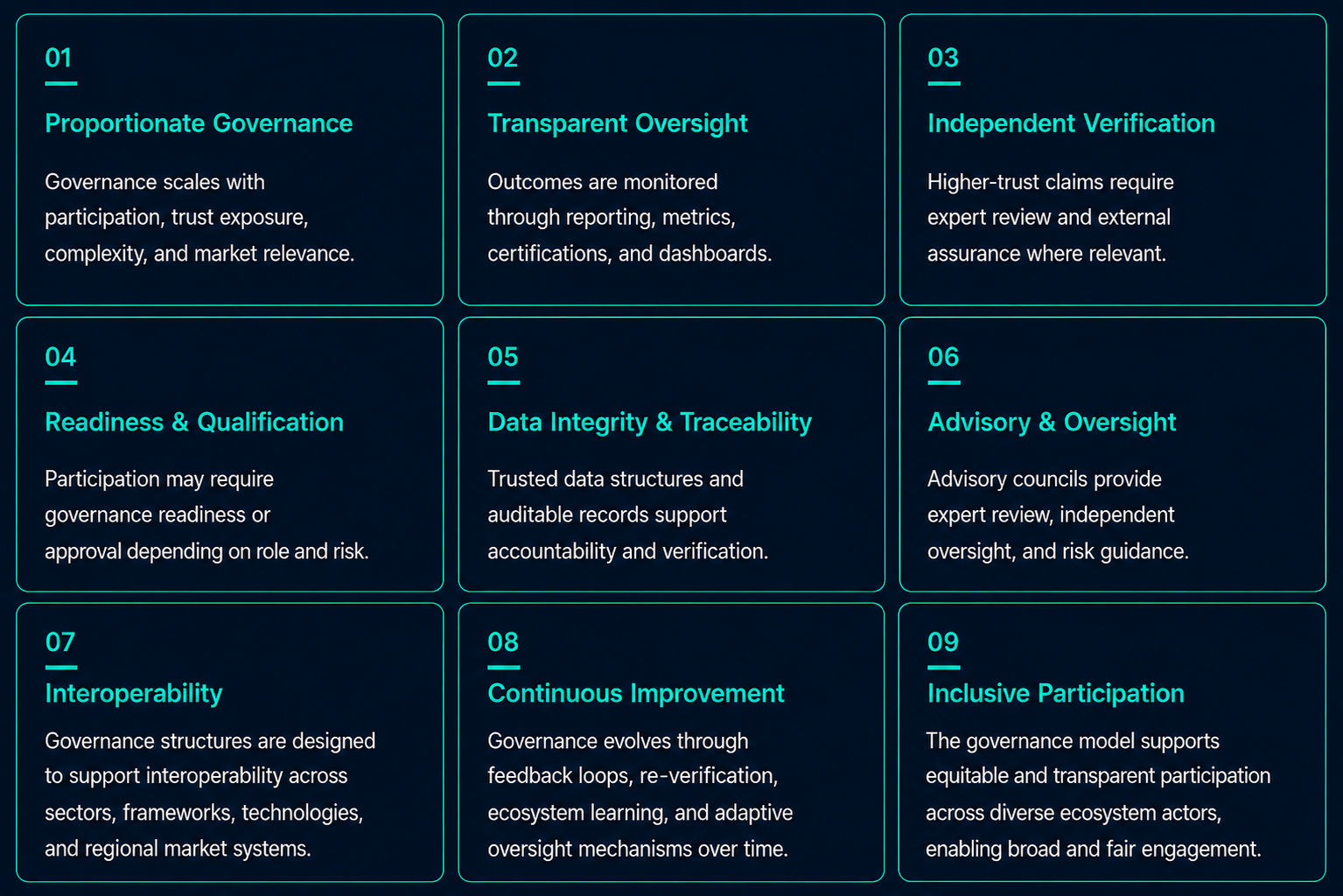
The FF Governance Model™ is guided by a set of core principles designed to
protect trust, ensure accountability, and enable scalable market participation.
As participation and ecosystem complexity increase, governance adapts through
appropriate oversight, qualification, verification, and transparent accountability.
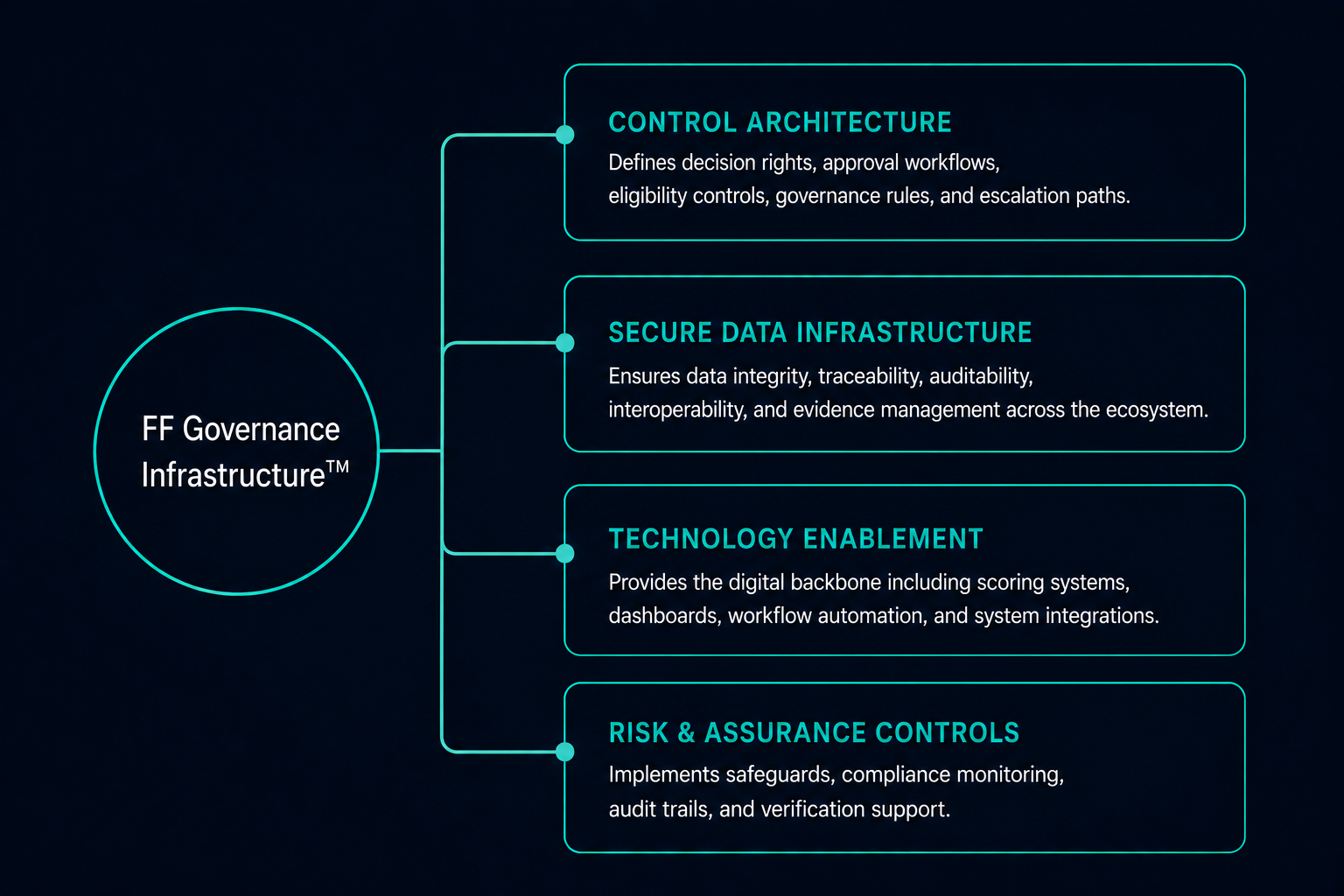
FF Governance Infrastructure™ combines control mechanisms, trusted
data architecture, and enabling technologies to support validation,
accountability, monitoring, and scalable ecosystem participation.
This creates the operational backbone for trusted ecosystem governance —
enabling secure transactions, accountable decision-making, trusted data exchange,
monitoring, and scalable digital execution across the full participation lifecycle.
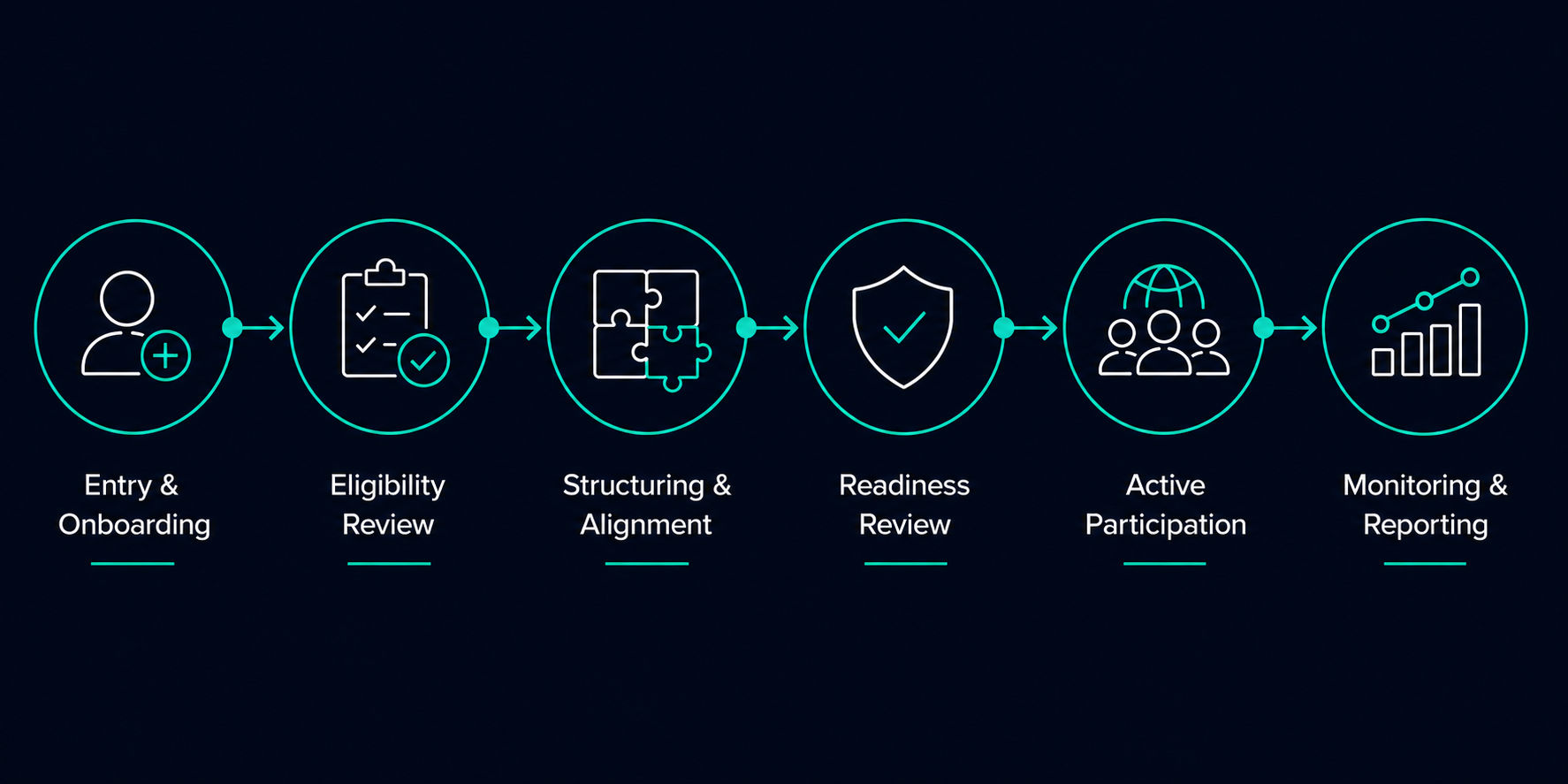
FF Participation Lifecycle™ defines how partners and solutions progress
through a structured process to ensure integrity, accountability, and credibility.
Governance continues beyond onboarding and verification through ongoing
monitoring, re-assessment, reporting, and continuous improvement.
The six-stage progression model below shows how partners, projects and solutions, move from
entry and onboarding to structuring, and trusted, investment-ready, and scalable participation.
The governance model is operationalized through a set of frameworks
and tools that enables measurable, transparent, and scalable execution.
These mechanisms translate governance principles into practical execution —
enabling trusted participation, transparent accountability, and scalable coordination.
All projects, solutions, and partners represented through the platform
undergo validation and readiness review as part of the governance framework.
Where specific claims, outcomes, or certifications require additional assurance, independent experts and auditors provide independant verification in accordance with standards. Over time, partners and ecosystem participants are encouraged to adopt comparable high-level standards.
Verification is designed not only to validate claims, but to create comparable, traceable, and decision-useful information for investors, partners, regulators, and ecosystem participants.
✓ Independent Review ✓ Audit-Ready Reporting ✓ Transparent Oversight